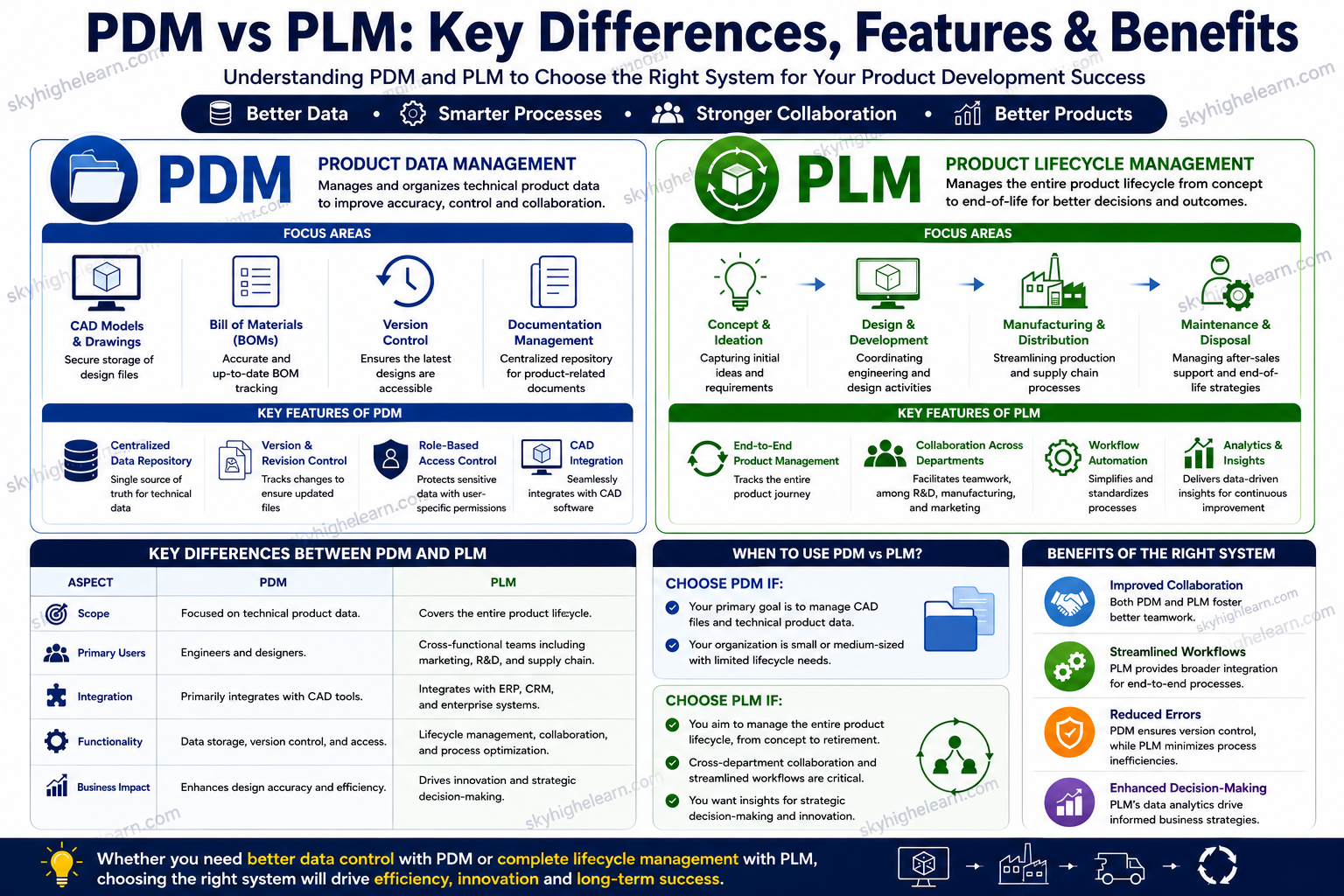
In the competitive landscape of manufacturing and product development, effective data management systems are essential. Two pivotal systems, Product Data Management (PDM) and Product Lifecycle Management (PLM), often surface in this context. While they share some similarities, PDM and PLM differ in scope, functionality, and impact. This blog explores these differences to help you choose the right system for your needs.
What is PDM?
Product Data Management (PDM) is a system designed to organise and manage technical product data. It primarily focuses on:
- CAD Models and Drawings: Secure storage of design files.
- Bill of Materials (BOMs): Accurate and up-to-date BOM tracking.
- Version Control: Ensuring the latest designs are accessible.
- Documentation Management: Centralized repository for product-related documents.
PDM systems improve collaboration among engineering teams by offering secure, traceable, and consistent access to product data.
Key Features of PDM
- Centralized Data Repository: Acts as a single source of truth for technical data.
- Version and Revision Control: Tracks changes to ensure teams work on updated files.
- Role-Based Access Control: Protects sensitive data with user-specific permissions.
- CAD Integration: Seamlessly integrates with CAD software to simplify workflows.
What is PLM?
Product Life-cycle Management (PLM) provides a holistic approach to managing a product’s journey from inception to end-of-life. PLM systems address:
- Concept and Ideation: Capturing initial ideas and requirements.
- Design and Development: Coordinating engineering and design activities.
- Manufacturing and Distribution: Streamlining production and supply chain processes.
- Maintenance and Disposal: Managing after-sales support and end-of-life strategies.
PLM enhances cross-functional collaboration, enabling informed decisions throughout the product lifecycle.
Key Features of PLM
- End-to-End Product Management: Tracks the entire product journey.
- Collaboration Across Departments: Facilitates teamwork among R&D, manufacturing, and marketing.
- Workflow Automation: Simplifies and standardises processes.
- Analytics and Insights: Delivers data-driven insights for continuous improvement.
Key Differences Between PDM and PLM
| Aspect | PDM | PLM |
|---|---|---|
| Scope | Focused on technical product data. | Covers the entire product life-cycle. |
| Primary Users | Engineers and designers. | Cross-functional teams including marketing, R&D, and supply chain. |
| Integration | Primarily integrates with CAD tools. | Integrates with ERP, CRM, and enterprise systems. |
| Functionality | Data storage, version control, and access. | Life-cycle management, collaboration, and process optimization. |
| Business Impact | Enhances design accuracy and efficiency. | Drives innovation and strategic decision-making. |
When to Use PDM vs. PLM
Choose PDM if:
- Your primary goal is to manage CAD files and technical product data.
- Your organisation is small or medium-sized with limited life-cycle needs.
Choose PLM if:
- You aim to manage the entire product life-cycle, from concept to retirement.
- Cross-department collaboration and streamlined workflows are critical.
- You want insights for strategic decision-making and innovation.
Benefits of Implementing the Right System
- Improved Collaboration: Both PDM and PLM foster better teamwork.
- Streamlined Workflows: PLM provides broader integration for end-to-end processes.
- Reduced Errors: PDM ensures version control, while PLM minimise process inefficiencies.
- Enhanced Decision-Making: PLM’s data analytics drive informed business strategies.
You also like to read:
Mechanical design engineering interview questions and answers.
Top 30 Hr interview questions and answers.