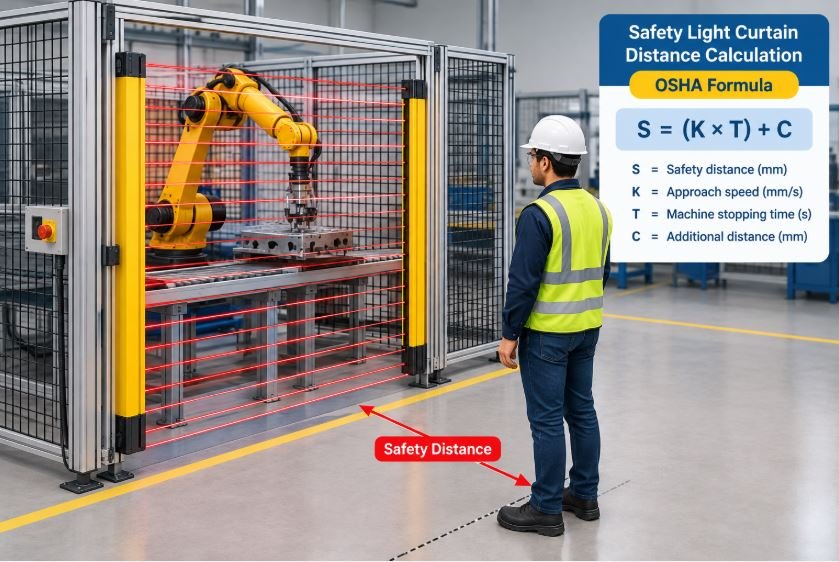
Safety Light Curtain Distance Calculation: A Complete Guide to OSHA Standards and Light Curtain Selection
Modern manufacturing facilities rely heavily on automation to improve productivity, reduce downtime, and enhance workplace safety. However, as machines become faster and more powerful, safeguarding operators becomes increasingly important. Therefore, installing a light curtain sensor is one of the most effective ways to prevent accidental access to hazardous machine zones.
Whether you operate robotic cells, hydraulic presses, packaging equipment, or automated assembly lines. Selecting the correct safety light curtain and installing it at the proper distance is essential. Moreover, understanding the safety distance for safety light curtains helps organisations comply with OSHA regulations while minimising workplace injuries.
In this comprehensive guide, you’ll learn everything about light curtain selection, light curtain safety sensor working, the light curtain safety distance formula, safe distance calculation for light curtains, applicable safety standards, and the OSHA stopping distance formula used by machine safety professionals.
What is a Light Curtain Sensor?
A Light Curtain Sensor is an electro-sensitive protective device (ESPE) designed to detect the presence of people or objects entering hazardous machine areas. Unlike traditional mechanical guards, safety light curtains create an invisible infrared barrier that instantly stops machine motion whenever the protective field is interrupted.
Typically, a safety light curtain consists of two primary components: an infrared transmitter and an infrared receiver.
The transmitter continuously emits multiple infrared light beams toward the receiver. Consequently, if any beam is interrupted by a hand, finger, arm, or body, the receiver immediately activates the machine’s safety circuit to stop hazardous motion.
Because safety light curtains do not require physical contact, they protect operators while improving productivity. As a result, they are among the most widely used machine-safeguarding solutions in modern industrial automation.
Understanding How a Safety Light Curtain Sensor Works:
Understanding how a safety light curtain works is essential before installation or selection. Its operating principle is simple and reliable: the transmitter sends synchronised infrared beams to the receiver, which continuously monitors each beam within milliseconds.
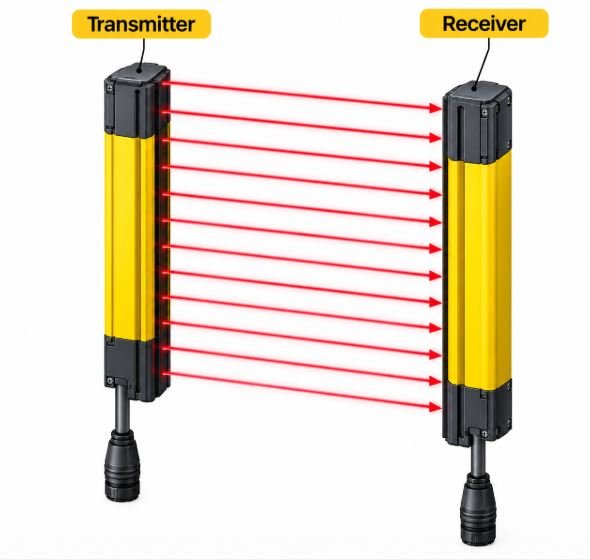
When an operator reaches into the protective field, one or more beams are interrupted. The safety controller or safety PLC then sends a stop signal to the machine. Stopping hazardous motion before the operator can reach the danger point. This process includes the response times of the sensor, safety controller, and machine, all of which must be considered in the safety distance calculation.
Why Safety Distance for Safety Light Curtains Is Critical
Installing a light curtain alone does not guarantee operator safety. Its distance from the hazard determines whether the machine has enough time to stop before an operator reaches the danger zone. If the sensor is installed too close to rotating blades, hydraulic presses, robotic arms, or other hazards.
The machine may not stop quickly enough to prevent injury. For this reason, engineers must accurately calculate the safety distance before commissioning the machine.
A properly calculated safety distance helps prevent operator injuries, meet OSHA requirements, support ANSI and ISO machine-safety standards, reduce workplace accidents, and improve risk-assessment accuracy. Proper installation also helps protect both employees and employers from unnecessary liability.
Light Curtain Safety Standards
Every industrial safety project should follow recognised light curtain safety standards. These standards define installation requirements, stopping-distance calculations, sensor performance, and risk-assessment procedures.
Commonly referenced standards include OSHA 1910, ANSI B11.19-2003, ISO 10218-1, and IEC 61496. Together, these standards help ensure that machine-safety systems meet regulatory requirements and provide effective operator protection.
OSHA Safe Stopping Formula
Determining the correct safety distance is one of the most important steps in machine safeguarding. According to OSHA 1910, ANSI B11.19-2003, and ISO 10218-1, the minimum installation distance is commonly calculated using the following formula:
Ds = K × (Ts + Tc + Tr) + Dpf
Where:
- Ds = Minimum safety distance
- K = Hand approach speed constant (assuming the walking speed of the operator towards machine)
- Ts = Machine stopping time
- Tc = Control system response time
- Tr = Safety light curtain response time
Standard K Values
The value of K depends on the applicable safety standard and the type of safeguarding application.
| Standard | Typical K Value | Description |
|---|---|---|
| OSHA / ANSI | 63 in/s (1,600 mm/s) | Standard hand approach speed for most machine safeguarding applications. |
| ISO 13855 | 1,600 mm/s | Used for calculating the minimum distance for safety light curtains and other presence-sensing devices. |
| Special applications | 2,000 mm/s | Used in some high-risk or body-approach calculations, depending on the risk assessment. |
- Dpf = Depth penetration factor based on sensor resolution
The Depth Penetration Factor (Dpf) is an additional distance included in the safety light curtain calculation to account for how far a person can reach through the protective field before the sensor detects the intrusion.
Where:
- Dpf = Depth Penetration Factor (mm)
- d = Sensor detection capability (resolution) in millimetres1.Finger detection – 14 mm2.Hand Detection – 25 mm
3.Arm/Leg/Body detection- 45mm
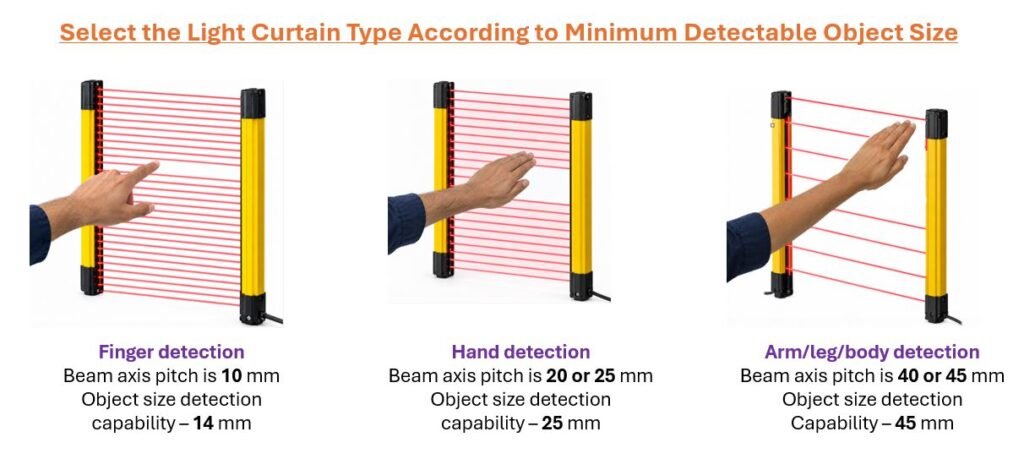
Select the Light Curtain Type According to Minimum Detectable Object Size
This formula helps ensure that hazardous motion stops before an operator can reach the danger point.
Factors That Affect Light Curtain Safe Distance Calculation
Several factors influence the safe distance calculation, including machine stopping time, sensor response time, safety PLC and relay response, light curtain resolution, detection capability, approach direction, risk-assessment results, guarding design, and operator reach distance.